DreamMoney · Financial AI · 2026
MoneyGuru
Making personalized financial advice accessible to everyone
Client
DreamMoney
My Role
End-to-end Research, Design & Development
Collaborators
Founders, PM, Data Science & Dev Team
Timeline
4 months
01 — Project Overview
“Only 9.5% of Indian households actually invest — not because they can’t, but because the tools that exist weren’t built for them.”
DreamMoney is a financial services platform dedicated to making personalized financial advice accessible to everyone, especially non-English speakers in Tier-2/3 cities. Serving over a million users, DreamMoney offers a full suite of financial services and products including investments (mutual funds, FDs and gold) and lending services.
The funnel data showed the drop-offs. The question was why?
02 — The Problem
The Macro Gap
Despite rapid digital adoption across India, retail investment rates stay persistently low. According to SEBI, while ~63% of Indian households are aware of financial products, only ~9.5% actively participate in securities/equity markets.
RBI data shows:
– Bank deposits make up 35–40% of total household financial assets, over 450 million bank accounts holding FDs.
– Traditional LIC products account for 16–18% of assets across 280 million policies, driven by a preference for guaranteed returns.
Equity — Nifty 50
~12%
↑ Grows real wealth
Fixed Deposits
4.9%
↓ Below inflation
Insurance (LIC)
4.5–5.5%
↓ At or below inflation
India’s inflation rate is 5.5% — FDs and insurance deliver negative real returns, quietly eroding the savings of millions.
Low or irregular incomes leave little surplus, while a lack of financial education and untrustworthy advice keep a significant portion of the Indian population outside formal investment ecosystems due to systemic, structural, and psychological barriers.
The Product-Level Drop-off
Through user interviews and platform audits, I identified that drop-offs in the investment funnel are not due to lack of interest — but a three-fold friction barrier:
73%
Indian population lacks financial literacy, as per NCFE (National Centre for Financial Education)
90%+
New internet users need non-English or conversational guidance
<5%
Investors access certified, unbiased financial advice
03 — User Research & Assumptions
Methods
To understand early-stage investor drop-offs, I conducted:
– ~12 User Interviews (earning ₹20k–₹1L+/month)
– Stakeholder Audits
– Competitive Audit of 8 apps: Groww, Fi, Paytm, Axis, 1% Club, Gullak, ABCD, MyFi

~12 User Interviews
Earning ₹20k–₹1L+/month

8 Competitive Analysis
Apps audited for UX gaps
Hypotheses I Was Testing
H1
Users drop off because financial jargon is intimidating.
H2
First-time investors prefer conversational, guided steps over complex dashboards.
Competitive Landscape & Gaps
Leading fintech platforms were evaluated to benchmark industry standards and surface usability gaps.

Fi
Groww

Axis Finance

1% Club

Gullak
Paytm

ABCD
MyFi
What the Research Validated
While these fintech platforms excel at transaction execution, the competitive audit combined with user interviews validated our core hypotheses and revealed three major barriers keeping Tier-2/3 users from taking action:
01
Jargon Overload
Dense financial language causes fatigue and drives instant drop-offs.
02
Decision Paralysis
Complex dashboards leave users unsure of what question to ask or what step to take next.
03
Trust Deficit
Hesitation to share sensitive financial data without real-time, transparent guidance.
04 — The Vision & Design Foundation
Bharat’s intuitive
financial guide.
To transform DreamMoney from a transactional app into a voice-first, multi-modal conversational AI — guiding non-English users step-by-step through decision points, regardless of literacy, language, or trust.
Northstar Metrics
Improve Conversion
Reduce Drop-off
Design Principle & Foundation
User Research + Competitive Analysis + Design & Business Goal = Designing for Trust, Clarity & Access
Talk in language users understand
Tell users everything — don’t let them assume
Always show a clear way forward — never leave users stranded
Let users shape how the AI responds
Design for experts and novice users
Use consistent & familiar designs for easy navigation
05 — The Solution Walk-through
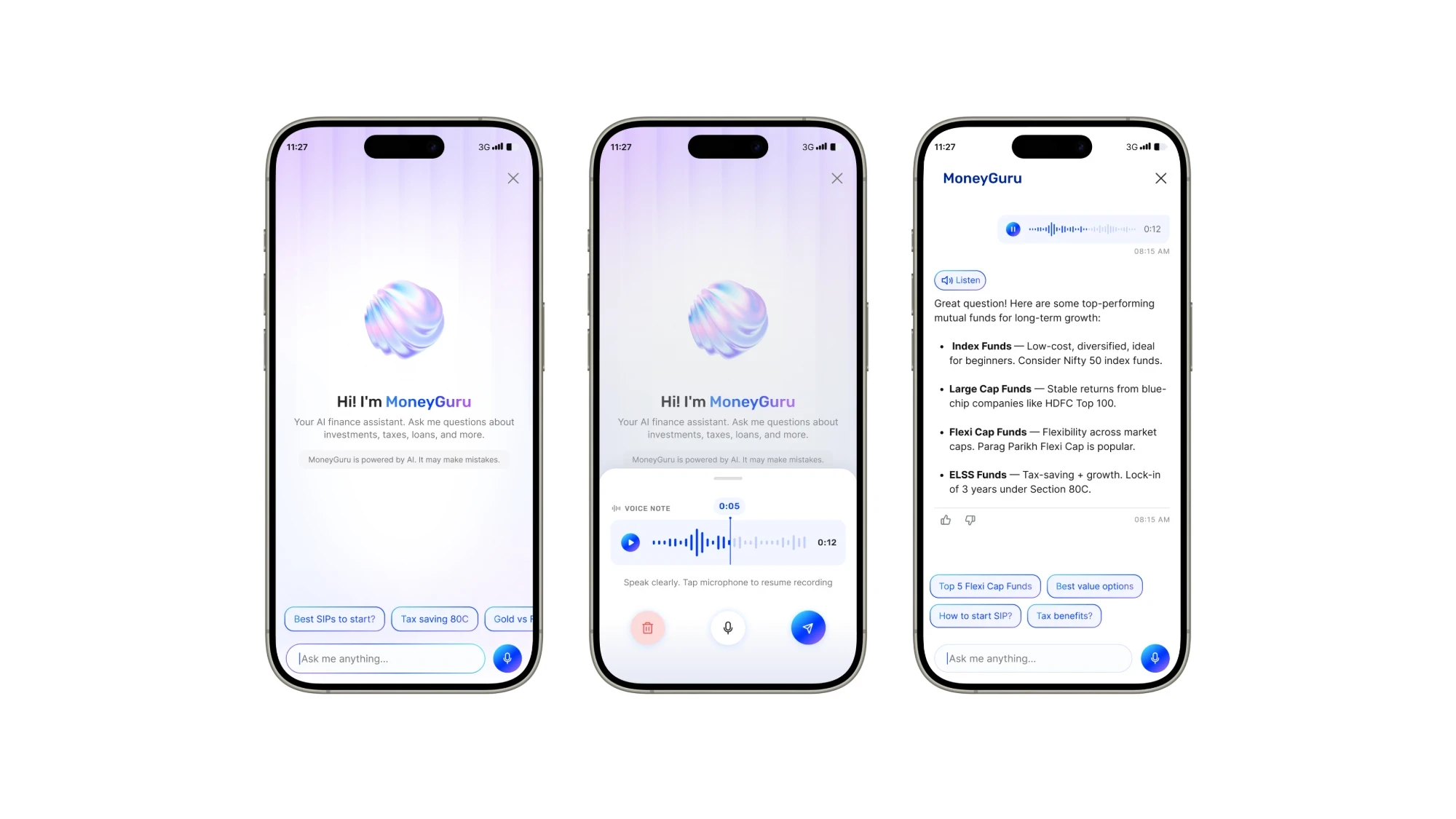
MoneyGuru was built as a multi-modal conversational AI assistant embedded directly into DreamMoney. It speaks the user’s language, explains financial concepts like a knowledgeable friend, and acts as a 24/7 advisor — turning financial anxiety into confident action at critical decision points. Together, these four features dismantle the three barriers in a single, accessible interface.
1
2
2
3
4
1
TTS playback with progress bar
Serves low-literacy users and on-the-go contexts
2
Text Streaming + Follow-up Chips
Eliminates what do I ask? anxiety
3
Inline Thumbs Up / Down Rating
Direct control for users; captures real-time AI training data
4
Voice input bottom sheet with preview
Removes barrier for non-typists and non-English users
06 — PROCESS DECISION HIGHLIGHTS
I defined character, tone, and boundaries before touching screens. A cohesive architecture governed by clear principles — from the FAB interaction to typography choices.
1
Research
Mapped user pain points, competitor gaps, and AI finance trends to surface trust barriers.
2
Information Architecture
Structured text and voice flows — decision trees, conversation paths, and compliance guardrails.
3
Visual Design
Built a visual language that balances credibility with warmth — approachable but trustworthy.
4
User Interface
Delivered a scalable design system and tested prototypes to validate flows quickly.
To convert drop-offs into active investors and build long-term user confidence, MoneyGuru was built as a multi-modal (text and voice) conversational AI assistant embedded directly into DreamMoney. It speaks the user language, explains financial concepts like a knowledgeable friend, and acts as a 24/7 advisor. It turns financial anxiety into confident action at critical decision points.
AI Persona
Five principles anchored every screen-level decision — from how the FAB behaves to the typography’s warmth. A cohesive three-screen architecture (Home → Hero Welcome → Chat Interface) governed by:
Simplicity
Human
Trusted
Playful
Bharat Ready
Key Decisions
Together, these are not just features. They are a deliberate dismantling of the three barriers — jargon, language exclusion, and the trust gap — in a single, accessible interface.
07 — DESIGN SYSTEM & HANDOFF
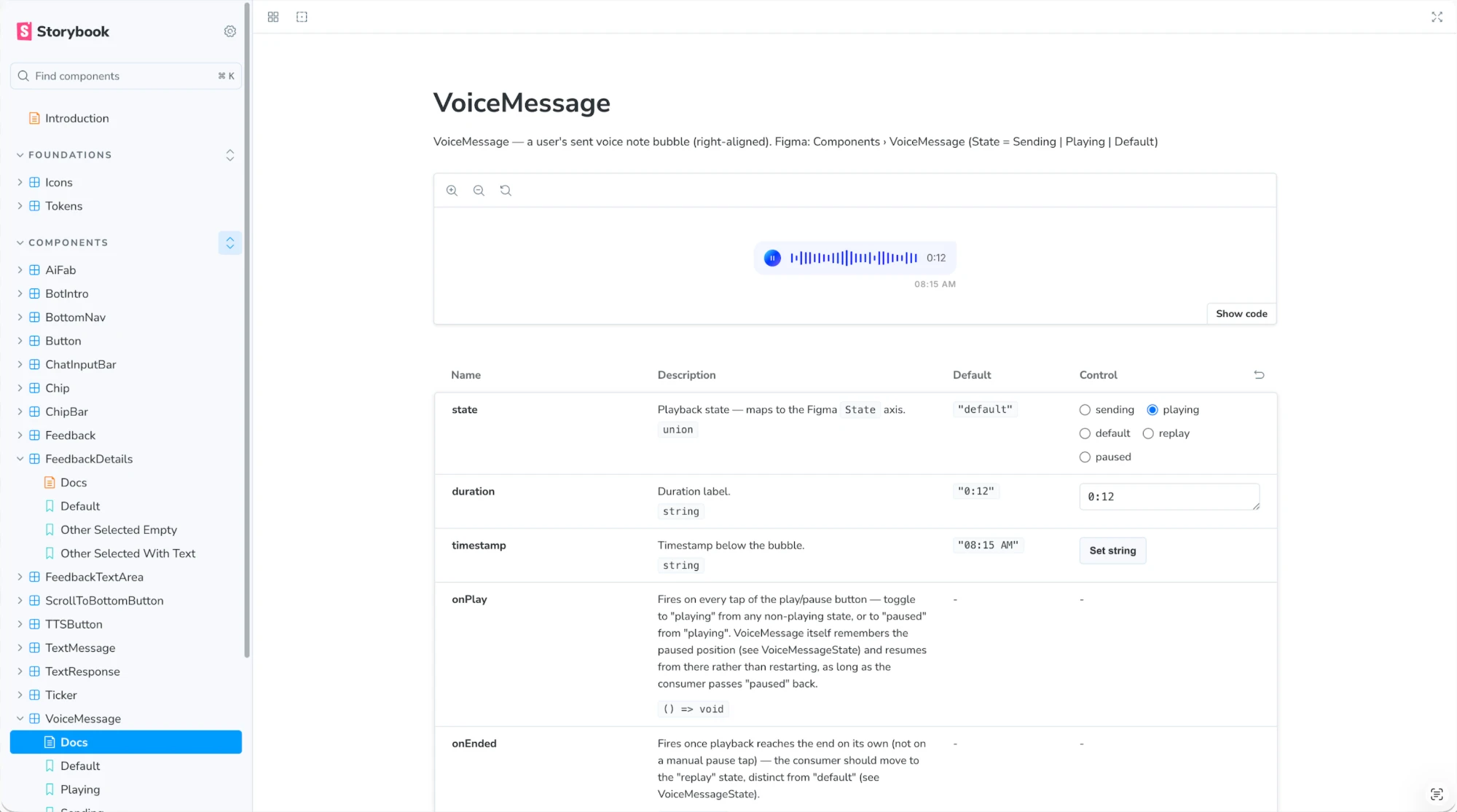
Established a tokenized design system in Figma, extracted components into Storybook, and published them as an npm package. Used Claude Code and Figma MCP to build a live React prototype and validated all interactions on physical mobile devices.
The pipeline: Design Tokens → Storybook → Claude Prototyping. Every component was built to be documented, shareable, and immediately handoff-ready for engineering.
08 — IMPACT
DIMENSION
OUTCOME
High-fidelity prototype
Functional prototype running on real devices with genuine AI responses — not a clickable mockup.
Reusable design system
Storybook components, documented and ready for engineering handoff.
Interaction modalities
Designed and validated — text chat, voice input, and AI audio output all tested on physical devices.
What’s Next
User testing on the investment funnel drop-off hypothesis
Validate whether the AI intervention meaningfully changes confidence and completion rates at KYC, fund selection, or first-investment confirmation.
Compliance and accuracy layer
Expand to a full guardrail system: factual grounding, regulatory disclaimers, and SEBI-compliant response boundaries.
Multilingual voice support
Voice is English-only right now. Hindi, Tamil, and Marathi are needed for it to reach the users it was built for.