MoneyGuru
App Design

DreamMoney: A wealth management platform helping users invest, save, and understand their personal finances. The product was functional but vocabulary-heavy — built fluently for people who already knew what a SIP or expense ratio was. For everyone else, the experience stalled at the language.
Client:
DreamMoney (Dream Sports)
Role:
Product Designer
Year:
2026
Explore the full story –
The Problem
Our target users want to manage their money better but get lost in jargon, mis-selling, or lack of guidance often ending up with sub-optimal decisions. Dream Money’s vision is to simplify finance and empower users to achieve their financial goals. However, unlike traditional finance apps that push products, we will differentiate ourselves by focussing on giving genuine advice. Hence, advisory forms the core value proposition of Dream Money. Currently, users leave the flow to search FAQs or contact support, creating high-friction context-switching that leads to funnel drop-offs and delayed investments. Typing in English and navigating complex financial forms creates significant friction, leading to high drop-off rates. Users with low smartphone proficiency struggle to understand textual steps, reducing their confidence in using the chatbot.
The Goal
To validate an AI-driven intervention that provides instant, highly accurate, and compliant resolutions to factual queries within the active app screen. By providing a low-latency (<5s) and empathetic support mechanism, we aim to increase user confidence, reduce knowledge-gap drop-offs, and drive higher completion rates in their investment journey funnel. By providing a voice-first modality, we aim to widen the top of the funnel, increase user confidence, and build brand trust through a warm, clear, and authoritative AI voice persona.
The Solution
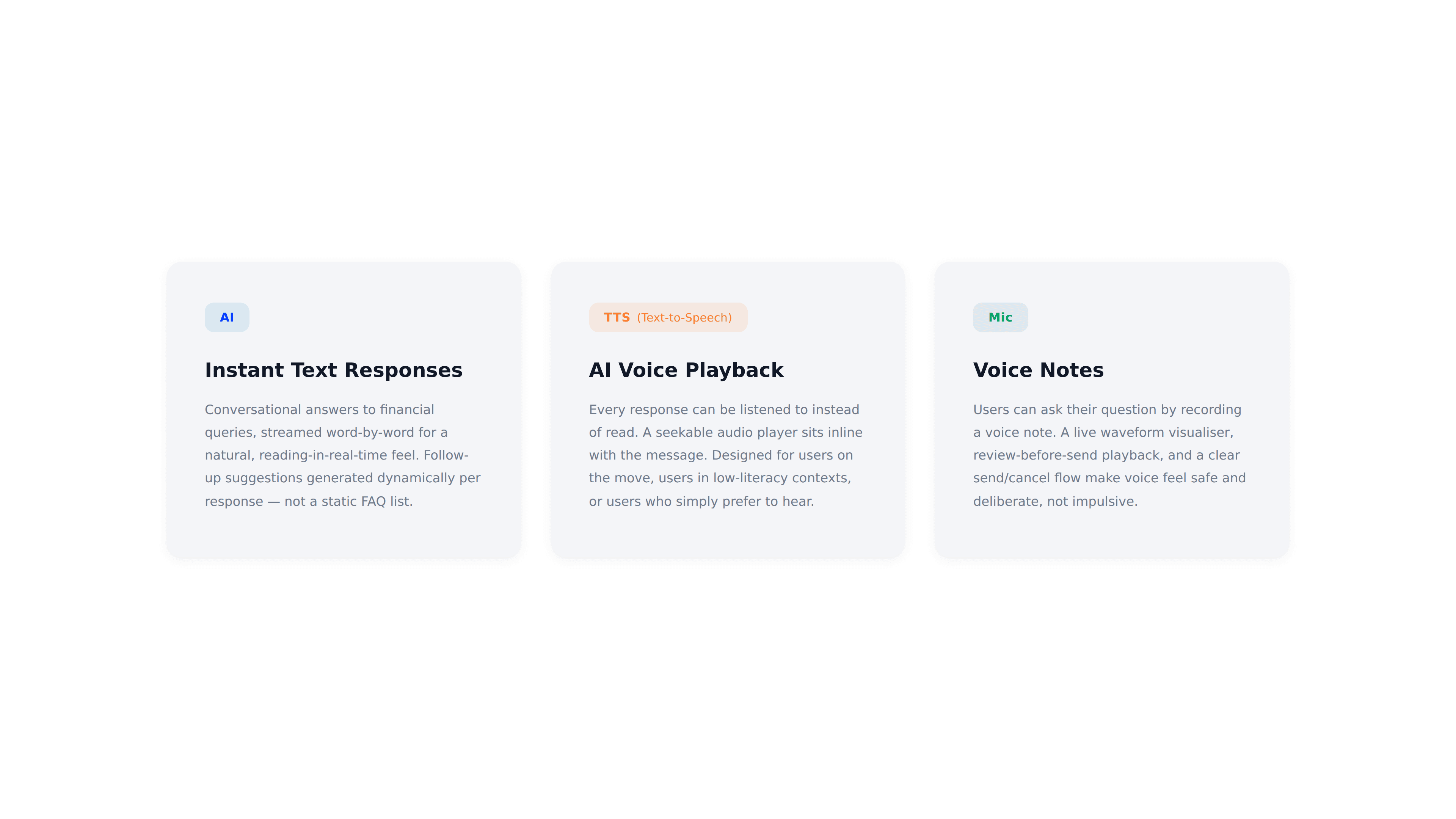
MoneyGuru: an AI-powered chat assistant embedded in the DreamMoney app, designed to resolve informational queries instantly, guide users through onboarding and transaction journeys via voice, and surface contextual prompt suggestions at the moments of highest friction. I owned the product end-to-end — from defining the brief to building and deploying the prototype — with no prior product to reference and no existing user data to start from.
1. Defining direction without existing data
This was a 0-to-1 build. No prior product, no research backlog, no baseline metrics. The brief was directionally clear — one-stop, interactive, always-on assistance — but the form was completely open. Rather than wait for data that didn't exist, I mapped the problem from first principles: where in the DreamMoney flow did users most likely feel lost? Finance jargon in onboarding. Complexity on investment product pages. Decision anxiety at transaction moments. These friction points became the design anchors for Phase 1. The north star was phased: Phase 1 would solve informational queries. Phase 2 would add voice and transaction journey support. A future phase would introduce prescriptive, portfolio-aware advisory — personalized guidance based on a user's holdings and risk appetite. We designed Phase 1 knowing exactly what it was clearing the ground for.
2. The hardest design decision: how much to guide
The core tension in any chat interface is control vs. effort. A fully open free-text input gives users maximum flexibility — and maximum cognitive load. In personal finance, that load compounds: users often don't know what question to ask, only that something feels unclear. My solution was contextual, one-tap prompt suggestions surfaced at key friction points across the app — not inside the chat, but embedded in the product flow itself. If a user lands on a screen about portfolio rebalancing, MoneyGuru proactively offers: "What does rebalancing mean for me?" The question is already formed. One tap and they're in the conversation. This was the design hypothesis at the centre of MoneyGuru: reduce the cognitive cost of asking, and you reduce the exit rate.
Dimension | The Outcome |
|---|---|
Design velocity | Phase 1 complete in 2 weeks; Phase 2 in 3 weeks — full design-to-handoff in under 6 weeks |
0-to-1 ownership | Sole designer on a cross-functional team of 8, from brief to shipped prototype |
Independent build | Coded, integrated, and deployed the working prototype when engineering resources were unavailable |
Documentation | Storybook component library built and handed off — production-ready, not just a spec |
Internal launch | MoneyGuru reached internal launch at DreamMoney, validating the core concept before the company closed |